Structural Drying and Dehumidification in Newbury Park, CA
Surfaces dry long before framing, subfloor and concrete do. The drying team sizes air movers and dehumidifiers to the class of loss and leaves the equipment until the structure itself reads dry.
☎ (888) 578-6508Set up structural drying now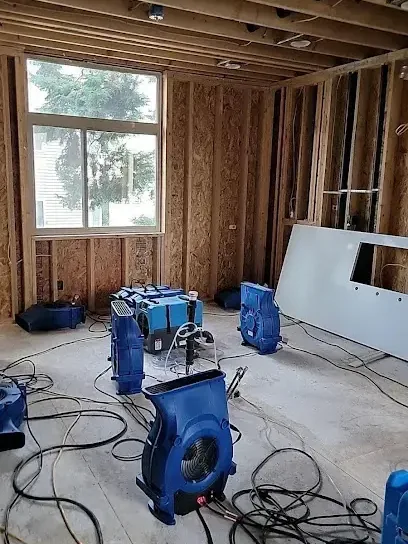
First steps for structural drying and dehumidification, right now
- 1
Stop the water
Close the main or the fixture valve first.
- 2
Open the house
On a dry day, open windows; on a damp day, keep them shut.
- 3
Move contents
Lift furniture and boxes off wet floors.
- 4
Do not paint or patch
Covering wet drywall traps the water inside.
Structural drying is the part of a water loss that a fan from the hardware store cannot do. Drywall, framing, subfloor and a concrete slab hold water deep inside, and a room can feel dry while the bottom plate of a wall is still wet. Left that way, wood swells, drywall crumbles and mold growth can start within 24 to 48 hours.
What does structural drying and dehumidification cost in Newbury Park, CA?
Here, structural drying typically runs $1,500 to $8,000, depending on the class of loss, how many rooms need equipment and how many days the drying takes. Rebuild is a separate cost.
One room, Class 1 or 2
- Air movers and one LGR
- Moisture map
- Daily logs
Several rooms, Class 3
- Walls opened where wet
- Several dehumidifiers
- Containment
Class 4 materials
- Desiccant drying
- Slab, plaster or hardwood
- Long drying run
Ranges are typical, not a quote: the water category, square footage, material class and how fast drying started move the number most. The water damage cost calculator gives a closer range.
Class of loss sets the equipment
- Class 1: a small area of low-porosity materials, little water absorbed
- Class 2: a whole room, carpet and the bottom of the walls wet
- Class 3: water from above, walls soaked high, ceilings wet
- Class 4: dense materials like concrete, hardwood and plaster that need special drying
Still wet inside the walls? The drying team works 24/7.
☎ Talk about the drying planHow the drying is controlled
Air movers sweep wet surfaces to speed evaporation, and LGR dehumidifiers pull that moisture out of the air. Desiccant dehumidifiers take over for slabs and hardwood. The drying team records temperature, relative humidity and grains per pound every day, which shows whether the air is actually pulling water out of the materials. Indoor air matters during drying, and the EPA indoor air quality pages explain why.
Inland air helps, then hurts
Dry summer air in the Conejo Valley speeds evaporation, but closed-up houses in winter storms stay damp. Equipment is adjusted to the house, not to the weather report. Wood framing is judged against how dry sound wood should be, the kind of benchmark the USDA Forest Products Laboratory studies.
How structural drying and dehumidification is handled, step by step
Map moisture
Meters and thermal imaging set the drying plan.
Size the equipment
Air movers and dehumidifiers matched to the class.
Log daily
Psychrometric readings show progress.
Pull on readings
Equipment leaves when materials read dry.
What every structural drying and dehumidification job is held to
Rapid local response
Dispatch runs around the clock, and active water is treated as urgent at any hour, weekends included.
IICRC S500 drying standard
Equipment is sized to the class of loss and stays until the readings say dry.
Claim-ready documentation
Moisture maps, daily logs and photos taken before anything is torn out.
Conejo Valley water know-how
Slab homes, garage water heaters, attic AC and winter hillside runoff.
Structural drying and dehumidification across the Conejo Valley
Coverage runs across ZIP 91320 and 91319: Dos Vientos, Casa Conejo, the Rancho Conejo business park and the streets off Borchard Road, Reino Road, Wendy Drive and Ventu Park Road.
Nearby coverage reaches Thousand Oaks, Westlake Village, Oak Park, Camarillo, Camarillo Springs, Santa Rosa Valley, Moorpark.
Related water damage services
Structural Drying and Dehumidification questions
What does 'dry' mean in structural drying?
Wet materials read within 2 to 4 points of a dry reference, the same material in an unaffected part of the home.
Why are there so many fans and dehumidifiers?
Equipment is sized to the room's evaporation load and class of loss. Too little equipment lets water sit long enough to damage framing.
Can I turn the equipment off at night?
It is better not to. Drying runs around the clock, and stopping it lets humidity rise and slows the whole job.
How long does structural drying take?
Most losses dry in three to seven days. Concrete, plaster and hardwood take longer.
What are psychrometric logs?
Daily records of temperature, relative humidity and moisture in the air. They show whether the drying conditions are actually pulling water out.
Does drywall always have to be cut out?
No. Drywall wet with clean water can often be dried in place. It comes out when it is swollen, crumbling or touched by dirty water.
House still damp after a leak? Get it dried to readings.
Surfaces dry first and fool people. The drying team keeps the equipment running until the framing and slab read dry.
☎ (888) 578-6508Drying team dispatch, day or night