Structural Drying and Dehumidification in Fillmore, CA
After the water is out, the structure still holds moisture. Dehumidifiers and air movers dry framing, subfloor and drywall, and daily readings show when the building is actually dry.
☎ (888) 578-6508Start structural drying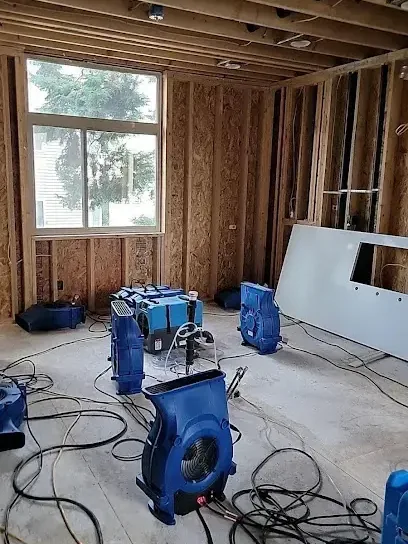
First steps for structural drying and dehumidification, right now
- 1
Chart the wet areas
A meter and an infrared camera mark each wet surface.
- 2
Size the setup
The right number of air movers and dehumidifiers goes into each room.
- 3
Open what holds water
Walls and floors are opened or drilled where moisture hides.
- 4
Read daily
Readings are logged until every material matches the dry reference.
Pulling water out is only half of a water loss. What remains is absorbed in wood, drywall, plaster and concrete, and it does not leave on its own in any reasonable time. Structural drying gives it somewhere to go: dry air flows across the wet surfaces, and dehumidifiers collect the moisture the air takes in.
What does structural drying and dehumidification cost in Fillmore, CA?
One room in Class 1 or 2 usually lands between $1,500 and $3,500, several rooms in Class 3 between $3,500 and $8,000, and Class 4 materials between $6,000 and $15,000.
Single room, Class 1 or 2
- Air movers set
- LGR dehumidifier
- Logged each day
Class 3, several rooms
- Wet walls opened up
- A few dehumidifiers
- Plastic containment
Class 4, dense materials
- Desiccant machines
- Plaster, wood, concrete
- Extended drying run
Ranges are typical, not a quote: the water category, square footage, material class and how fast drying started move the number most. The water damage cost calculator gives a closer range.
How the equipment works
- Air movers create a steady flow across floors and wall surfaces
- LGR dehumidifiers remove moisture from the air in the room
- Walls are opened or drilled where moisture sits behind them
- Equipment is repositioned as readings show where drying lags
More equipment is not always better; placement decides the drying rate.
Moisture left in the framing keeps working long after the visible water is gone.
☎ Plan the dryingHow drying jobs are classed
Class 1 and 2 jobs involve limited wet materials and take the least equipment. Class 3 jobs soak walls and ceilings from above, and Class 4 jobs involve dense materials such as hardwood, plaster and concrete that release water slowly and may call for desiccant drying.
Knowing when it is dry
A floor can feel dry while the framing below still reads wet. Readings are compared with an unaffected reference, and equipment comes out only when the wet materials match it. The logs, photos and readings then go to the adjuster. Related work includes water extraction before drying and hardwood floor water damage for wood.
How structural drying and dehumidification is handled, step by step
Map
Meters and a camera find every wet surface.
Set up
Air movers and dehumidifiers are placed to match the room.
Monitor
Daily visits adjust equipment as readings change.
Release
Equipment leaves once readings match dry.
What every structural drying and dehumidification job is held to
Rapid local response
Dispatch runs around the clock, and active water is treated as urgent at any hour, weekends included.
IICRC S500 drying standard
Equipment is sized to the class of loss and stays until the readings say dry.
Claim-ready documentation
Moisture maps, daily logs and photos taken before anything is torn out.
Conejo Valley water know-how
Slab homes, garage water heaters, attic AC and winter hillside runoff.
Structural drying and dehumidification across Fillmore and nearby communities
Drying equipment is placed in homes and shops across ZIP 93015, covering downtown, the Los Serenos tract, Heritage Grove, Grand Avenue and the neighboring communities of Bardsdale and Piru.
The same service nearby: structural drying and dehumidification in Newbury Park, Moorpark, Santa Paula.
Related water damage services in Fillmore
Structural Drying and Dehumidification questions
Why does drying take several days?
Moisture sits deep in wood, plaster and concrete and releases slowly, so dry air and dehumidifiers need time to draw it out.
What is an LGR dehumidifier?
LGR means low grain refrigerant, a design that keeps removing moisture even as the air in a wet room gets drier.
Do walls have to be opened to dry them?
Sometimes. Drilled holes or removed baseboards give air a path into the cavity, and a wall is cut open only if readings show it cannot dry that way.
How do readings show a building is dry?
Each wet material is measured against the same material in an unaffected part of the building, and drying ends when the numbers agree.
Is the equipment noisy and expensive to run?
It is loud and uses real power, which is one reason equipment comes out as soon as readings allow.
Can drying start before repairs begin?
Yes, and it must. Rebuilding over wet materials traps moisture, so repairs wait until the structure reads dry.
Dry the structure to the readings
Call after the water is out, and the crew will map the moisture, set the equipment and log the readings until the structure is dry.
☎ (888) 578-6508Set the equipment