Thousand Oaks has medical, biotech, office, retail, school and university buildings, and Thousand Oaks Boulevard is the main downtown commercial street. When water gets into any of them, the problem is not only damp floors but a business that has to keep running.
Key takeaways
- A commercial water loss is planned around operations: which rooms can close, which must stay open and what equipment cannot get wet.
- Extraction and containment come first, then phased drying by zone.
- Records, stock and equipment are lifted and protected before the floors are touched.
- Offices, clinics and shops each have different priorities, so the plan changes with the space.
- Tenants and landlords share questions about who handles what, so notes and photos matter.
Why a commercial loss is different
A house has one household and one set of rooms. A commercial building can hold many tenants, shared hallways, shared restrooms and one set of building systems.
Floors are larger, hours matter and customers or patients expect the space to open. The mix in the city includes medical, biotech, office, retail and school and university buildings, and each carries its own risks.
Thousand Oaks Boulevard anchors downtown retail and dining, and well known landmarks include The Oaks shopping mall and the Thousand Oaks Civic Arts Plaza.
- Water can cross tenant boundaries through shared ceilings and walls.
- Large floor areas need more equipment and more careful moisture mapping.
- Closing a space has a cost that a home does not have.
- Shared systems such as restrooms and break rooms often cause the leak.
- Several owners and a property manager may all need updates.
The first day for a business owner or tenant
A water loss at work calls for a clear head and a short list. The goal is to stop damage and keep people safe while protecting what matters most.
The first calls go to the landlord or building manager and to the restoration team, since one controls the building and the other controls the drying.
- Shut off the water source if it is safe and reachable.
- Call the building manager or landlord at once.
- Keep people out of wet areas and away from electrical equipment.
- Photograph the water, the damage and the equipment at risk.
- Move critical records, stock and electronics to a dry spot.
- Arrange extraction before the water spreads under walls.
Protecting records, stock and equipment
A business can replace carpet more easily than a client file or a point of sale system. Priorities decide what moves first.
Paper and electronics
Paper records, computers and data equipment are the first items lifted. Water that is not near an outlet can still reach cables and power strips along the floor, and a wet server room needs a technician before anything is powered on.
- Computers and servers are raised or moved.
- Boxes of files go to a dry room on a shelf or table.
- Power strips and cords are lifted off the floor.
Stock and furniture
Retail stock on low shelves, cardboard cartons and upholstered pieces soak up water. They are lifted early or protected with plastic.
A short written list of what moved and where it went saves a great deal of searching later.
- Cartons are moved to a dry area.
- Furniture is raised onto blocks.
- Wet stock is photographed and counted before it is discarded.
- Salvageable items are dried or cleaned before they go back on shelves.
Phased drying so the business keeps going
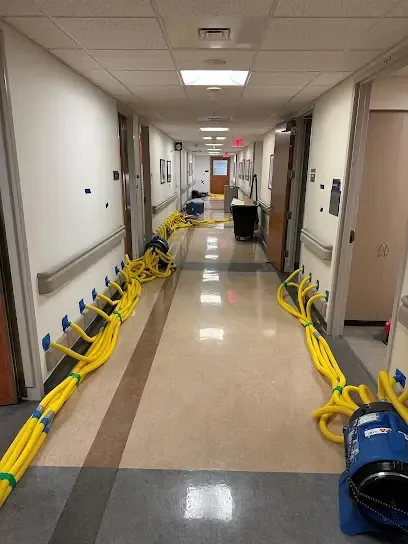
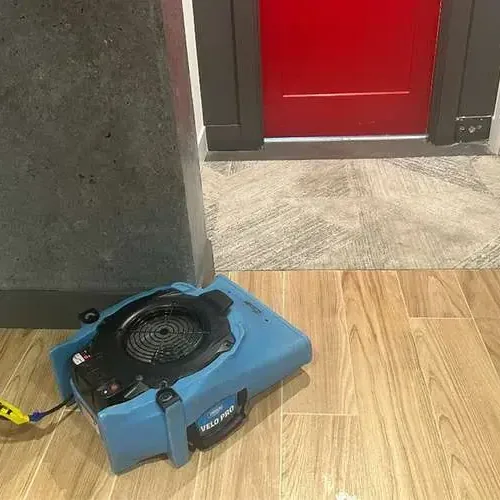
Commercial drying is organized by zone. The crew sets up containment, runs drying equipment where the readings call for it and keeps unaffected areas open when possible.
Large floors need careful mapping. Moisture readings are taken across a grid, and the readings show which parts of the floor and walls are still wet.
The structural drying process explains how zones are scheduled so work can continue around opening hours and tenants.
- Wet zones are separated with plastic containment.
- Equipment is placed to limit noise and cord hazards in busy areas.
- Readings are taken each visit, and equipment is moved as zones dry.
- Zones that dry first reopen first.
Offices, clinics and retail spaces
The same water loss looks different depending on the space. The plan follows the use of the building.
One loss can touch more than one use, such as a medical suite beside an office beside a shop, and each zone gets its own plan.
Offices
Cubicle floors, carpet tile, ceiling tile and server rooms are the usual concerns. Carpet tile can sometimes be lifted, dried and reset, while ceiling tile that got wet usually has to go.
Cubicle walls and desks can often stay in place if they are lifted off the wet floor.
Clinics and medical suites
Patient areas are kept clean and protected while drying runs in the rooms beside them. The clinic follows its own infection control rules, and the plan works around them.
Retail spaces
Display areas, stock rooms and entrances need quick attention so customers can return. A stock room often holds the most water damage because cartons sit low.
- Entrances are dried first so customers can return.
- Stock rooms are checked for water under shelves and cartons.
- Signs and temporary mats keep shoppers away from wet floors while drying runs.
Tenants, landlords and documentation
Who handles a repair depends on the lease and the building, so tenants and landlords both need the facts. Dated notes and photos give them common ground.
The crew can also tell tenants which zones will reopen first, which helps them plan.
The commercial water damage service in Thousand Oaks and the main commercial water damage page describe the full process. The full range of local services lists the rest.
- Notify the landlord or manager in writing.
- Keep dated photos of the water, the damage and the work.
- Save receipts for emergency costs and replaced items.
- Keep drying readings, which show when each zone reached the dry reference.
- Ask the crew for a written list of what was removed and why.
Questions
Can a business stay open during water damage cleanup?
Often a part of it can. Wet zones are contained and dried while dry zones stay open, and the plan depends on which rooms are affected and which equipment cannot get wet.
What should be saved first after a water loss at work?
Records, computers and anything that cannot be replaced. Stock and furniture follow, and carpet and ceiling tile come last because they can be replaced. A short list taped inside the office door helps staff act quickly.
Does the landlord or the tenant handle the drying?
That depends on the lease and the building. The drying should not wait for that conversation, and notes and photos help both sides.
How are clinics handled differently?
Patient areas are protected and kept clean while drying runs nearby. The clinic infection control rules shape how containment and equipment are set up.
How does the crew know a zone is dry?
Moisture readings. The crew takes them each visit and records them, and equipment moves only when a zone reaches the dry reference.
What records help a landlord or manager?
Dated photos, the moisture readings and a list of what was removed. Together they show what was wet, how far it spread and when each zone reached the dry reference.