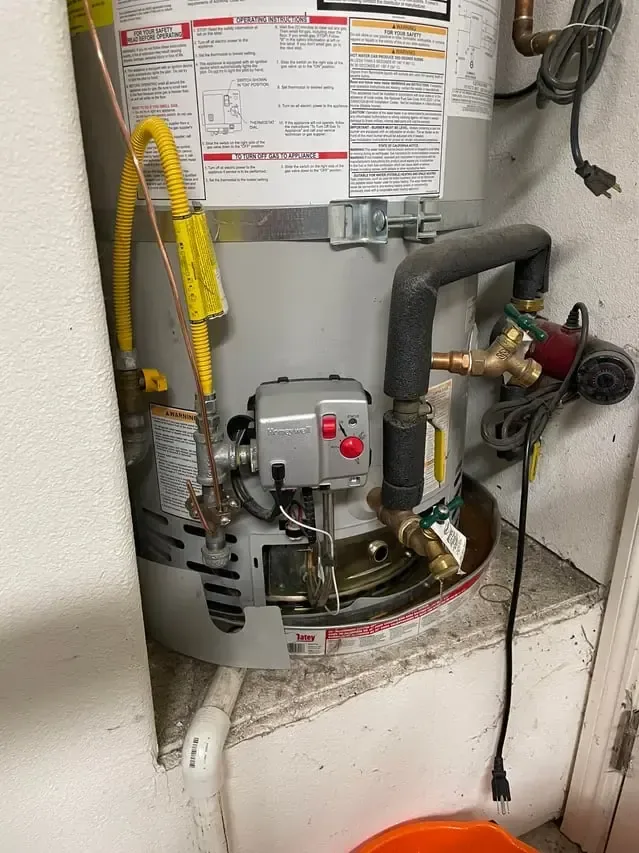
In many Newbury Park homes the water heater stands in the attached garage, close to a wall shared with the house. When the tank fails, the water has only a short trip from the concrete floor to the drywall and flooring on the other side.
Key takeaways
- Close the cold water supply valve at the tank first, then shut off the gas control or the breaker for an electric unit.
- A tank that leaks from its body is replaced, and the cleanup can start before the new tank goes in.
- Water slips under the bottom of the shared wall, so both faces of that wall need moisture readings.
- Cardboard boxes and anything stored on the garage floor soak up water fast and are moved first.
- The City of Thousand Oaks Building Division lists water heater replacement among its permit types, so the replacement is worth planning with the installer.
What a failed tank does in a garage
A full tank holds enough water to cover a garage floor and keep spreading toward the lowest, driest corner.
Newbury Park is mostly ranch and tract homes from the 1960s to the 1980s, with Dos Vientos built out from the late 1990s on. In many of them the attached garage holds the water heater.
That layout puts a tank a few steps from living space, which is why a garage leak is rarely only a garage problem.
- A seam or weld gives way and the tank empties in a rush.
- A fitting or valve weeps for weeks before anyone looks.
- The relief valve discharges and runs onto the floor.
- Rust at the base of the tank points to water seeping through the lining.
The first steps at the tank
The first goal is to stop new water and keep the household safe. Everything else waits for those two things.
If the tank valve will not turn, the main shutoff for the house stops the same flow. Knowing where both valves are saves a great deal of water on a bad day.
- Close the cold water supply valve on top of the tank.
- Turn off the gas control, or the breaker for an electric unit, before going near wet equipment.
- Stay out of standing water if outlets, cords or a spare freezer sit in it.
- Photograph the tank, the floor and anything damaged before moving it.
- Lift boxes, tools and stored items off the floor and onto dry shelves.
How water gets from the garage into the house
Concrete does not soak up water, so the water travels. It follows the slope of the floor, finds the door threshold and slides under the bottom plate of the shared wall.
The shared wall
Drywall wicks water upward from its bottom edge, and the insulation inside the wall holds it there. A wall can look dry on the garage side while the house side is wet.
- Baseboards and trim on the house side are checked first.
- Moisture meters read the lower drywall on both faces.
- A thermal camera shows cool, wet areas behind the paint.
Flooring in the nearest room
Carpet, pad and laminate in the room next to the garage pick up water from the edge inward. Water extraction in the garage and that first room usually happens in one visit.
Hard floors such as tile move water along grout joints and under thresholds. Laminate can swell at the seams, and the planks are judged one at a time.
- Carpet edges are lifted near the wall to check the pad.
- Laminate seams are checked for swelling.
- Tile and grout are read with a meter, not judged by eye.
What extraction and drying involve
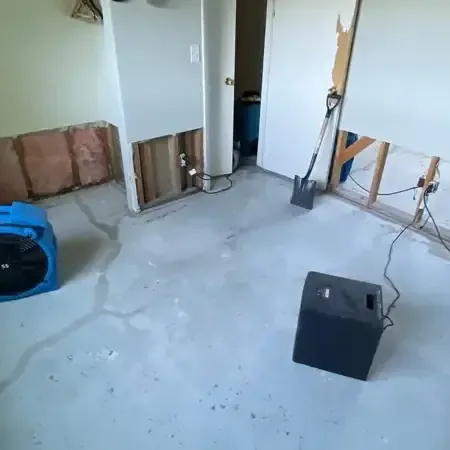
The crew pulls standing water with an extraction wand, then maps moisture across the garage slab, the shared wall and the rooms beyond it.
Wet insulation and soaked drywall at the bottom of the wall are cut out. Air movers and dehumidifiers then run until the readings match a dry reference.
The method follows the structural drying process, and a water heater leak cleanup runs from extraction through the final readings.
Equipment runs are set by the readings, not by a fixed number of days. A garage slab and a wall cavity can need different amounts of drying.
- Soaked insulation behind the tank wall is removed instead of dried.
- Drywall that stayed wet is cut out at a clean height.
- Laminate or carpet pad that cannot dry in place is lifted.
- Stored cardboard and paper goods are sorted and discarded.
Signs the leak went past the garage
A leak that looks small on the slab can still have traveled. Some signs show up only on the house side.
When any of these appear, a moisture check of the rooms beside the garage is the safest next step.
- Baseboards that feel soft or look swollen near the shared wall.
- Paint that bubbles or stains low on the wall.
- Carpet that feels damp or smells stale near the garage door.
- A hallway floor that looks fine but sounds hollow when tapped.
Replacing the tank and the Thousand Oaks permit question
A tank that leaks from its body is replaced, not patched. Newbury Park is a community inside the City of Thousand Oaks, and the city Building Division lists replacement of water heaters among the permit types it handles.
That makes the installer the right person to ask whether a permit is being pulled. Fees and timelines come from the city, not from the restoration crew.
The drying and the replacement can run side by side, so the garage does not have to wait for the new tank. Homeowners next door in the city can read about the Thousand Oaks water heater leak page for the same steps.
Keeping the next tank from flooding the garage
Tanks usually give warning before they fail. Rust at the base, a weeping fitting, a relief valve that drips or damp cardboard under the tank all point to trouble.
A replacement is also the right moment to ask about a drain pan and where its drain pipe runs.
- Look at the base of the tank whenever the garage door is already open.
- Keep stored items on shelves instead of on the floor around the tank.
- Make sure everyone in the home knows where the cold water valve is.
- A drain pan with a drain pipe catches small leaks, though a full tank failure can overflow it.
Questions
Can a leaking water heater be repaired instead of replaced?
A leak from the tank body means the steel has failed, and the usual answer is a new tank. A leak at a fitting or valve can sometimes be fixed by a plumber without replacing the tank.
Does the garage floor need drying if the water stayed on the concrete?
Water on concrete spreads to the edges and under stored items, so the floor, the base of the walls and the door threshold are checked with a moisture meter. Surface water is extracted first, and the readings decide what else is needed.
What should be moved out of the garage first?
Cardboard, paper and fabric items go first because they wick water quickly. Tools and electronics follow, then anything resting on the floor near the tank.
Is the shared wall always opened?
Not always. Readings and a thermal camera show whether water reached the wall cavity, and when the bottom of the drywall and the insulation are wet, a low section is cut out so the cavity can dry.
Who handles the new water heater?
A plumber or installer handles the tank, the connections and any permit. The restoration crew handles the water, the wet materials and the drying readings.
Can the garage still be used while drying equipment runs?
Usually only for access. Cords, hoses and wet floors make the space a poor place to work or park, and the equipment needs clear room to dry the slab.